
In this article:
You hired a respected consulting firm to lead campaign strategy. Smart move. They bring analytical rigor, feasibility study expertise, and a track record that gives your board confidence.
Then you hired a talented creative agency to produce your campaign materials. Also smart. They bring visual storytelling, brand craft, and the kind of design quality that makes your institution proud.
Both firms are doing strong work. Your consultant delivered a thorough strategic plan. Your agency produced a beautiful case statement. But something isn’t clicking the way you expected. The campaign has all the right pieces. It just doesn’t feel whole.
Here’s what we’ve observed across more than 100 campaigns: the problem isn’t your partners. It’s the space between them.
The Market Trained Us to Separate What Should Be Whole
The nonprofit fundraising advisory sector has always divided itself into two camps. On one side: consulting firms that provide strategic counsel, feasibility studies, and campaign architecture. On the other: creative agencies that produce case statements, campaign websites, and donor-facing materials. Both are skilled. Both are necessary. And the separation between them was never a strategic choice. It was an artifact of how the industry organized itself.
The result? Institutions preparing for transformational campaigns are expected to act as general contractors, managing separate vendors with separate timelines, separate points of contact, and separate understandings of your campaign’s core rationale. That coordination burden isn’t a minor inconvenience. It’s a structural vulnerability that shows up in five specific ways.
Five Ways the Gap Costs You
1. The Translation Tax
Your consultant spends weeks in discovery, interviewing stakeholders, analyzing your donor pipeline, and producing a strategic framework that captures the campaign’s essential rationale: why now, why here, why this.
Then that document gets handed to a creative team that wasn’t in the room for any of it.
What follows is a translation process that inevitably loses nuance. The strategic framework becomes a creative brief. The brief becomes a draft. The draft goes through revision cycles between two firms that don’t share a common vocabulary for your campaign’s intent. The case for support ends up saying the right things without quite meaning them. It’s accurate but not alive. And donors, especially sophisticated major-gift prospects, can feel the difference.
2. The Timeline Penalty
Sequential handoffs are expensive. The consultant completes their phase. The creative agency onboards. There’s a learning curve, a getting-to-know-you period, a round of “can you walk us through the strategy deck?” meetings. Then the creative work begins.
In our experience, this sequential process adds six to twelve months to the campaign timeline compared to an integrated approach where strategy and creative develop in parallel. For a campaign in its quiet phase, when momentum and urgency matter most, that’s time you can’t afford.
3. The Coordination Burden
Someone on your advancement team is now managing the relationship between your consultant and your agency. Scheduling joint calls. Ensuring that the creative team has the latest version of the strategic framework. Mediating when the agency’s creative direction doesn’t align with the consultant’s recommendations.
This is work your advancement team didn’t budget for, doesn’t have bandwidth for, and shouldn’t need to do. Every hour spent on vendor coordination is an hour not spent on donor cultivation. And in the separated model, this coordination role falls to you by default because neither the consultant nor the agency owns the integration.
4. The Fluency Gap
This is the failure mode we’ve written about extensively, and it’s the most consequential.
A creative agency that doesn’t spend its days in the world of advancement may not have deep familiarity with gift tables, solicitation psychology, or how a development officer actually uses a case statement in a donor meeting. Without that context, it’s natural to optimize for visual impact over conversational utility, or to write for inspiration rather than adaptation.
The result is materials that look compelling on a conference table but don’t translate easily into donor conversations. Not because the creative work is poor, but because the creative team was never given the fundraising context that would have shaped their decisions differently. We’ve seen this pattern across sectors. And the gap is almost always structural, not a reflection of anyone’s talent or effort.
5. The Accountability Void
When leadership gifts come in below expectations, or the quiet phase timeline stretches, or volunteer leaders lose confidence in the messaging, who owns the problem?
In the separated model, the answer gets complicated. The consultant may see a creative execution issue. The agency may see a strategic framing issue. And the advancement team can find itself mediating between two partners who each delivered on their scope but didn’t jointly own the outcome.
This isn’t anyone’s fault. It’s a structural gap. When strategy and creative are delivered by separate teams with separate accountabilities, the integration—the most important part—belongs to no one.
The Problem Is the Model, Not the People
Let me be clear about something: many of the best campaign outcomes we’ve been part of have involved close collaboration with consulting firms whose strategic work was outstanding. The analytical rigor, institutional knowledge, and campaign architecture that experienced consultants bring is genuinely difficult to replicate. And the creative agencies working in this space include firms doing beautiful, thoughtful work.
The issue isn’t the quality of either partner. It’s that the traditional model asks them to work in sequence when campaigns succeed by working in concert. The answer isn’t to replace either partner. It’s to rethink the model so that strategy and creative operate as a unified force from day one.
What the Alternative Looks Like
We call our approach counsel-led communications. It’s not a new label for the same creative agency model. It’s a fundamentally different relationship between strategy and creative, where senior fundraising counsel drives every communication decision from the earliest stage of campaign conception.
Here’s what that means in practice: Foster Avenue doesn’t do feasibility studies or manage campaigns. Your fundraising consultant does that. What we do is sit at the strategy table from the very beginning, alongside your consultant, so that the people shaping your message platform, writing your case for support, and training your team are present for every strategic conversation that informs those deliverables. There’s no handoff. No translation. No creative brief passed across a conference table from one firm to another.
That’s different from firms that have added an in-house communications practice on top of a consulting model. In those cases, communications is often a support function serving the consulting engagement. In our model, communications is the strategic through-line that binds discovery to execution to sustainability. The people doing the creative work carry fundraising judgment because they’ve been doing this work, at campaign scale, for decades.
We saw this at DePaul University, where the same strategic thinking that shaped the message platform for a $650 million campaign also guided the development of eleven unit-level cases and the fluency training that equipped more than 200 ambassadors to articulate the campaign in their own words. The materials and the team capability developed together because they were never treated as separate workstreams.
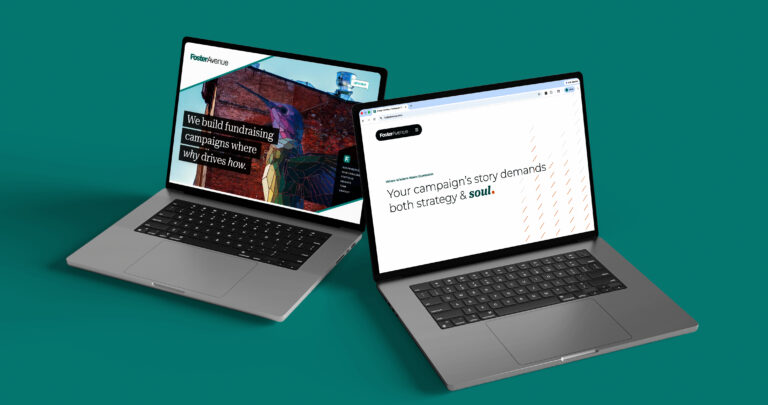
(We wrote more about this philosophy, and what it looks like in our own positioning, in a recent post about our site redesign.)
Three Questions Worth Asking
We’ve seen institutions transform their donor relationships by focusing on three key areas. If you’re planning a campaign or evaluating your current partner structure, these questions can help you assess whether you have an integration gap:
- Can your creative partner explain your gift table? Not in general terms. Specifically. Can they tell you why your lead gift is set where it is, and how the case for support needs to function differently for a $10 million prospect versus a $500,000 prospect? If not, your materials are being designed without fundraising intelligence.
- Who owns the space between strategy and creative? If the answer is “our advancement team,” you’re absorbing a coordination cost that’s pulling bandwidth from donor relationships. If the answer is “nobody, really,” you already know the problem.
- When was the last time your consultant and your creative partner were in the same room? If it doesn’t happen regularly, at every major milestone, not just the kickoff, then the two halves of your campaign are developing independently. And independent development produces independent outcomes.
The Path Forward
The separated model persists because it’s familiar, not because it works best. Most institutions don’t realize what integration could look like because they’ve never experienced it. They accept the coordination burden, the timeline penalty, and the fluency gap as normal costs of doing business.
They’re not. They’re the costs of a market structure that was designed around how firms organize themselves, not around how campaigns succeed.
The answer, we believe, is not creative agencies that run feasibility studies or manage campaigns, but an agency that is involved from the very beginning of campaign conception alongside your fundraising consultant—one that brings counsel-infused communications discipline to bridge the traditional gap and accelerates campaign momentum and ownership for all.
If any of this sounds familiar, and the idea of Foster Avenue’s “counsel-led communications” sounds like the solution, we’d welcome the conversation.