
In this article:
At Foster Avenue, we spend our days helping institutions answer three deceptively simple questions: Why now? Why here? Why this? These questions are the backbone of every campaign messaging platform we build. They force clarity. They expose weak assumptions. And they make it very hard to hide behind vague language.
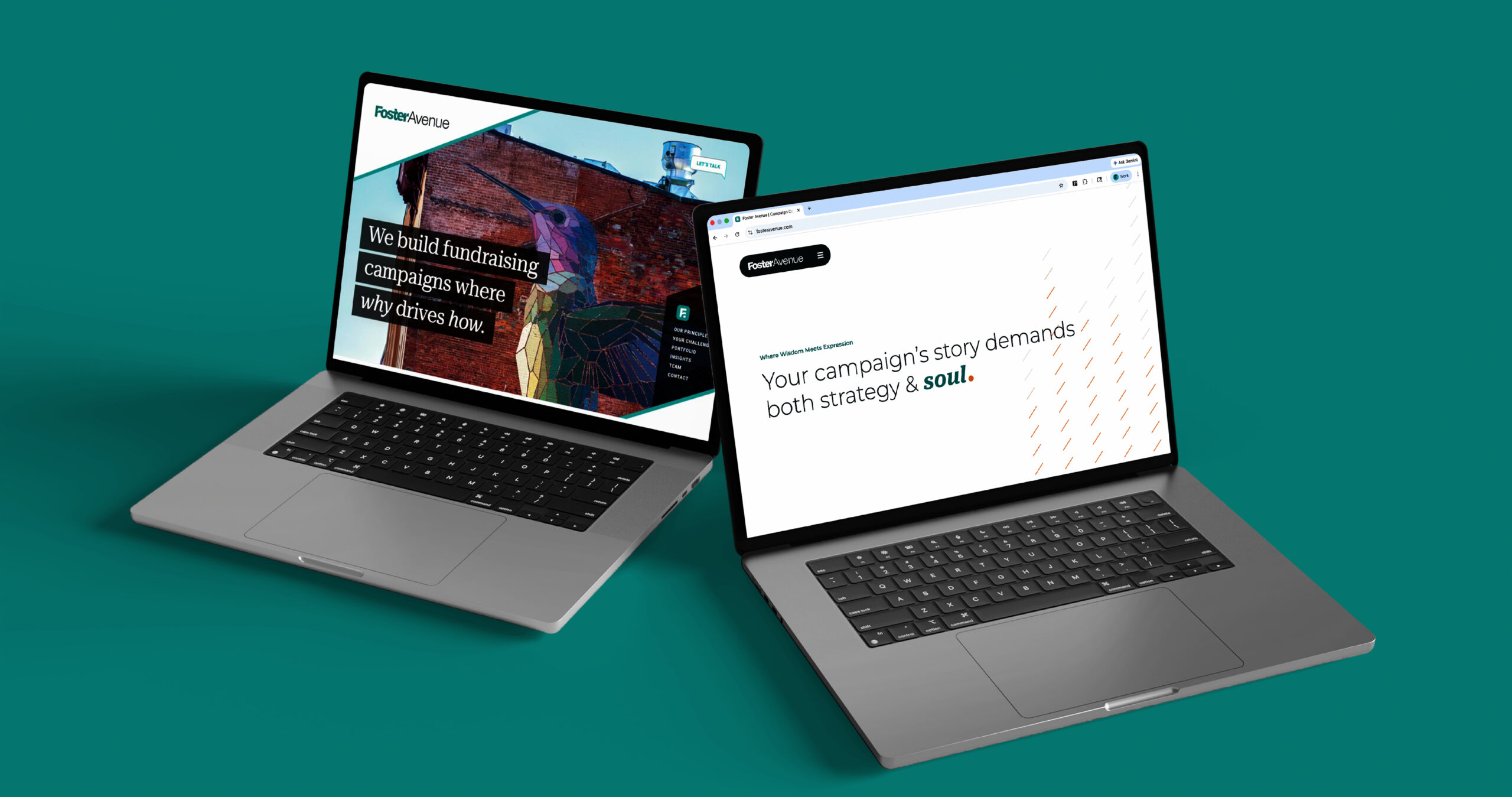
So when we turned that same lens on our own website, the answer was clear: our positioning had not kept up with our firm’s rapidly changing model. Foster Avenue has evolved significantly over the past several years. What we do now—what we call counsel-led communications—is the integration of senior fundraising strategy with world-class creative execution, delivered by the same team, from the same table, across the full campaign lifecycle. That’s how we’ve worked for a while. Our website was still describing an earlier chapter of the firm. It was time for the site to catch up to the practice.
What the new site delivers
We like to think of our new website as a demonstration of what we advise our clients, applied to our own story.
First and most important: lead with solutions, not philosophy. Our previous site asked visitors to absorb our worldview before we’d even told them what we deliver. The new site inverts that. It opens with what advancement leaders are actually looking for: campaign counsel, creative communications, case statements, fluency training, donor engagement strategy. The philosophy is still there. It just lives where it belongs—underneath the practical value.
The second choice was structural: focus on outcomes, not deliverables. We see many clients who present funding opportunities based on what they do rather than what they achieve. We took our own advice, summarizing our capabilities into five areas. Each one represents a real dimension of campaign performance that we’ve seen drive results across more than 100 engagements:
- Strategic Clarity — Institutional complexity distilled into a compelling narrative so donor conversations start from strength, not explanation.
- Authentic Expression — Creative execution grounded in advancement expertise, where every design decision reinforces fundraising strategy.
- Organizational Fluency — Staff and volunteers who can articulate the campaign in their own words, long after our engagement ends.
- Personal Resonance — Personalized communications that connect institutional priorities to what each donor cares about most.
- Lasting Capacity — A team that combines all the above to launch your next campaign launches faster, stronger, and from higher ground.
The third choice was about proof. We published our first case studies, drawn from campaigns in higher education (DePaul University, $650M), healthcare (Children’s Hospital of Philadelphia, $1B), and cultural institutions (Oglebay Foundation, first-ever comprehensive campaign). Each one follows a structure that mirrors how we actually think: what was the strategic challenge, how did we approach it, what did we build, and what were the results. We chose to lead with the challenge, not the portfolio piece, because that’s what counsel-led communications looks like in practice. The strategy comes first. The creative follows from it. We see many clients who present funding opportunities based on what they do rather than what they achieve. We took our own advice, summarizing our capabilities into five areas. Each one represents a real dimension of campaign performance that we’ve seen drive results across more than 100 engagements:
What stayed the same
The site still sounds like us – like a senior advancement professional talking to a peer. No hollow superlatives. No speed-and-volume promises.
Our tagline, “where wisdom meets expression,” captures the tension we live in every day. Wisdom is the 40+ years of campaign experience, the pattern recognition, the understanding of donor psychology and gift table dynamics that only comes from doing this work at scale. Expression is the creative craft that makes all of that thinking visible, emotional, and persuasive. Most firms offer one or the other. We believe the best campaigns require both, working together from the very beginning.
Why this matters to the institutions we serve
Here’s the practical motivation: Our more on-target website now lets us avoid spending the first 20 minutes of every meeting explaining what we do and how we’re different. The new site does that explanatory work before the first conversation happens.
A VP of Advancement exploring campaign partners can now see what he or she needs: our full service architecture mapped across five campaign phases: Articulation, Planning, Leadership, Public, and Wrap/Pivot.
(That last phase matters. Most firms focus on planning and execution and go quiet after the goal is met. We’ve built an explicit practice around what happens after the celebration, because post-campaign momentum is where lasting institutional capacity gets built or lost).
On the other hand, a president or CEO visiting the site encounters a different layer: the high-level positioning, the case study outcomes, the credibility of 100+ campaigns and $35B+ raised. They don’t need the phase-by-phase detail. They need confidence that we’ve done this at their scale, in their sector, with their level of complexity. Mission accomplished.
The broader principle
We hold ourselves to the same standard we apply with clients: is your positioning immediately clear to the audiences that matter most? Our redesigned site answers that question for two distinct audiences, with one coherent story.
If your institution has grown, changed leadership, merged programs, launched new priorities, or simply matured in ways your website and campaign materials don’t yet reflect, you’re probably leaving qualified conversations on the table. The people who need to find you are making judgments based on what you’re showing them, not what you’re capable of delivering.
That’s true for a fundraising consultancy. It’s equally true for a university, a health system, or a cultural institution preparing for its next campaign.
If that sounds familiar, we’d welcome the conversation.