
UNC Greensboro
Light the Way: The Campaign for Earned Achievement
The Story the Numbers Couldn’t Tell
UNC Greensboro ranked No. 1 in social mobility among every university and college in North Carolina, enrolled more than 20,000 students, and sent 94,000 alumni into the state’s workforce. None of that had ever been articulated as a case for major philanthropic investment. The university’s access mission was its greatest strength, but its fundraising story hadn’t caught up yet: when your student body is 52% Pell-eligible and one-third first-generation, the case for philanthropic investment has to lead with outcomes, not demographics.
What we faced:
- First campaign at this scale with no messaging precedent
- An access story that deserved a bolder fundraising frame
- Unit-level stories disconnected from the campaign case
- Top-ranked outcomes not yet central to the donor conversation
$266M
RAISED
33% ABOVE CAMPAIGN GOAL
#1
Social mobility in NC
52%
students pell-eligible
Setting the Stage
The Starting Point
UNCG had the ingredients for a major campaign. Chancellor Franklin D. Gilliam, Jr. had built real institutional momentum. The strategic plan, “Taking Giant Steps,” was in motion. Campaign co-chairs Randall R. Kaplan and Susan Morris Safran ’77 were already raising money before the materials existed. The university’s student body—52% Pell-eligible, one-third first-generation—was producing nationally ranked social mobility outcomes. Individual schools brought serious credential: Health and Human Sciences led all UNCG units with $11.49M in research funding and nationally ranked programs; University Libraries served 1M+ users annually and housed the world’s largest cello music archive. And 94,000 alumni lived in North Carolina, with 30,000 concentrated within 25 miles of campus.
What UNCG didn’t have was a case that matched the scale of a $200 million ask. The university’s strongest proof points were scattered across units, and the campaign lacked a unifying argument that could hold at both the institutional and school level.

Engagement Overview
Strategic Context
CAMPAIGN PHASE ENTRY
Comprehensive Campaign Launch
ENGAGEMENT MODEL
Integrated Counsel and Communications
DURATION
July 1, 2017 - December 31, 2025
PARTNER COLLABORATION
Chancellor’s Office, Advancement, Unit Leadership
The Strategic Work
Strategic Discoveries
Access Is the Proof, Not the Problem
The conventional approach would frame UNCG’s demographics as a need: help our underserved students. Foster Avenue reversed the posture. A university that’s No. 1 in social mobility in North Carolina isn’t asking for help—it’s offering a proven investment. The campaign led with outcomes and track record, positioning Pell eligibility and first-generation enrollment as evidence of performance, not a case for charity. That reframe shifted the donor ask from gratitude to confidence: you’re accelerating a model that already works.
The Regional Workforce Argument
Alumni concentration in the Piedmont Triad wasn’t just a loyalty base—it was an economic argument. Foster Avenue positioned the campaign so that a donor in Greensboro funding UNCG scholarships wasn’t writing a check out of affinity but investing in the health professionals, teachers, social workers, and business owners already running their region. That distinction—regional investment versus institutional loyalty—changed the donor psychology and widened the prospect pool beyond traditional alumni giving.
Unit Stories Needed the University Spine
Each school could make a compelling case independently. But without a shared architecture, units were competing for donor attention rather than reinforcing a single institutional argument. Foster Avenue built a messaging structure that gave each school room to lead with its own strengths while connecting every unit-level story back to the central campaign rationale. The result: a donor reading the Health and Human Sciences case and a donor reading the University Libraries case would both walk away understanding what UNCG does and why it matters now—even though the specifics they encountered were entirely different.

Our Framework Applied
Why Now? Why Here? Why This?
Foster Avenue applied its “Why Now? Why Here? Why This?” framework to build the campaign rationale from external urgency inward to specific investment opportunities.
Why Now?
Tomorrow’s North Carolina workforce is sitting in UNCG classrooms today.
North Carolina’s workforce shortages in health care, education, and applied research are accelerating. UNCG is already graduating the people who fill those roles at scale, with 94,000 alumni in the state and 30,000 within 25 miles. The students are coming regardless. Without scholarships, endowed faculty, and program investment, they arrive at an institution that can’t match their ambition.
Why Here?
The university proves that access and excellence aren’t opposites.
UNCG takes students from small rural towns, growing suburbs, and major cities across every economic stratum and moves them up. Elite institutions claim these outcomes; UNCG proves them for the population that needs it most. Founded as a women’s college in 1891, now one of the most diverse campuses in the UNC system, with a nearly 130-year record of barrier-breaking.
Why This?
Fund the engine. Double the faculty. Build for what’s next.
Access funds scholarships for the 52% who are Pell-eligible and the third who are first-generation. Excellence more than doubles endowed professorships to forty, attracting faculty who attract students. An enterprising outlook creates flexible endowment tied to the strategic plan, built on the premise that the most important priorities a decade out may not exist yet.
The Creative Work
How Strategy Became Story
Light the Way came from Minerva. The Roman goddess of wisdom has been UNCG’s guiding symbol since the university’s founding days, her torch extended toward anyone ready to take it. Her earliest known appearance is on the institution’s earliest diploma, in 1894. The subtitle did the strategic work: “The Campaign for Earned Achievement” drew the line between inherited advantage and proven performance. UNCG students earn their outcomes. The campaign’s job was to make donors feel that distinction.
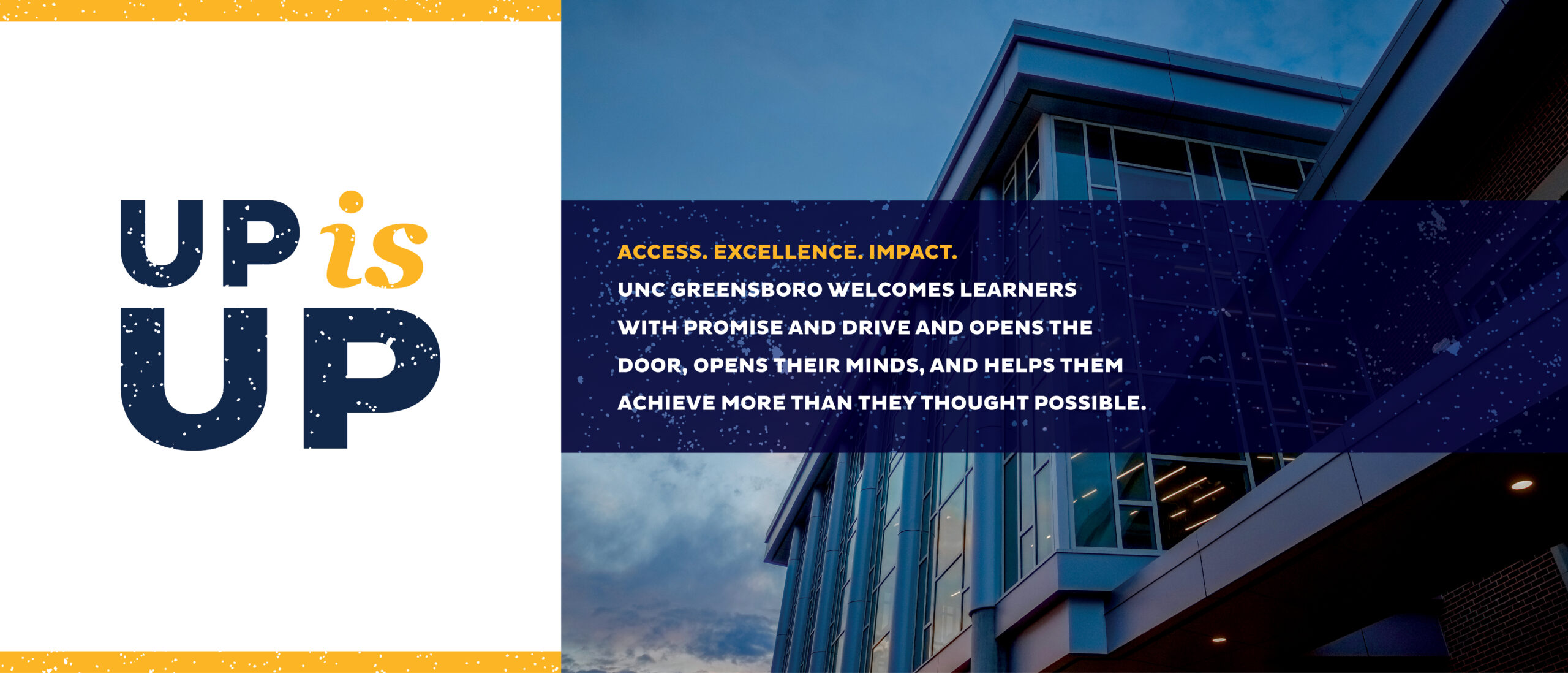
The “Up is Up” motif carried the argument visually. When UNCG students rise, the communities around them rise. That framing turned access data into something a donor could feel rather than scan. Joshua Hodge ’21, one of eight children raised by a single mother in Asheboro, first in his family to attend college, put a face on the 52% Pell-eligible statistic. Dr. Ratnasingham Shivaji, Helen Barton Excellence Professor of Mathematics, grounded the faculty investment case in a named scholar doing specific work. The numbers earned their place because the people behind them were visible.
The real test came after launch. A brand built for a kickoff had to carry through eight years that reshaped higher education, from a pandemic to a fast-changing university. It held. The identity was strong enough to anchor the campaign from day one and open enough to grow as UNCG grew, never locking the institution into the moment it was created. By the close, the language that launched Light the Way was still the language UNCG used to describe itself. That is the value of a campaign brand built right. It stops being a campaign asset and becomes part of how the institution speaks.
CAMPAIGN Theme

Positioning Statement
UNC Greensboro welcomes learners with promise and drive and opens the door, opens their minds, and helps them achieve more than they thought possible.
The Deliverables
Strategy Made Visible


Leadership Case for Support | Campaign Prospectus
A 16-page campaign case statement that opened with student futures rather than institutional history. The “Up is Up” visual motif, the “Carry the Torch” closing appeal, and the three-pillar investment structure gave leadership a document that could work in a boardroom presentation or a one-on-one donor meeting.

Unit-Level Collateral | Health and Human Sciences Trifold
A unit case piece leading with HHS’s applied research identity: $11.49M in research funding (top across all UNCG units), nationally ranked programs in Human Development (No. 4), Kinesiology (No. 15), and Peace and Conflict Studies (No. 2). Connected school-level priorities to the campaign’s Access-Excellence-Impact framework.

Unit-Level Collateral | University Libraries Trifold
Positioned the library system as the university’s democratic infrastructure: Over a million annual users, more than 1,200 instruction classes, distinctive special collections (world’s largest cello music archive, Triad Black Lives Matter Protest Collection, Betty H. Carter Women Veterans Historical Project). This made the case for the Jackson Library renovation and collection investment.

Campaign Brand Identity | Campaign Visual System and Letterhead
The campaign logo, visual identity system, and branded stationery maintain consistency across all donor correspondence and campaign materials. The Minerva shield and Light the Way lockup carried the campaign’s emotional register into every printed and digital touchpoint.
The Deliverables
The Brand, Carried Forward
UNCG’s brand team adopted the Light the Way visual identity for their campaign launch and close magazines—proof that a brand earns its place when an institution makes it their own.

Campaign Launch & Close Magazines
“Earned achievement” became embedded in UNCG’s institutional vocabulary. They incorporated the campaign’s identity into talking points, started calling themselves an “earned school” and incorporated the light rays into multiple tangible applications, including a building currently under construction.
Two magazines bookended the campaign: a launch issue in Fall 2021 and a closing issue in Spring 2026. Both covers were designed by UNCG alumni, the Fall 2021 cover by Antwain Hairston ’21 and the Spring 2026 cover by Patrick Leger ’06 MFA, extending the campaign’s identity into the hands of the people it was built for.
Let's Talk About Your Campaign
Whether you need creative services, strategic counsel, or want to explore our integrated approach—we’re here.