
The Guthrie Clinic
Here. For Good. The Campaign for Guthrie
Published November 5, 2026
Defining the Problem
The Challenge
The Guthrie Clinic had spent more than a century delivering care across rural Pennsylvania and New York. Now it was preparing a landmark philanthropic campaign designed to support the next phase of growth and impact. But operational excellence and philanthropic ambition required different vocabularies, and Guthrie’s development team didn’t yet have the messaging architecture to make the case for investment at this scale.
What we faced:
- A shifting landscape: rural hospital closures made donor skepticism about long-term viability a real obstacle to giving
- A strong patient marketing identity that hadn’t yet been translated into philanthropic language
- Four campaign priorities requiring a unifying narrative thread
Campaign goal
Service region
Hospital campuses
Setting the Stage
The Starting Point
When The Guthrie Clinic began planning its largest philanthropic campaign, the challenge went beyond fundraising mechanics. Rural healthcare across America was contracting. Hospitals were closing, services consolidating, communities losing access to care that urban populations take for granted. Guthrie needed more than a campaign; it needed language equal to the moment, one defined by accelerating change, regional expansion, and the imperative to invest locally in people and facilities.
The six-hospital campus system had built genuine operational momentum. Patient volumes were rising, the award-winning Guthrie Pulse Center was showing how experienced remote nurses and clinicians, working as one team with in-person staff, could bring specialist-level care across vast rural distances, and strategic acquisitions had expanded the network’s reach. But translating that momentum into philanthropic urgency required something the development team hadn’t yet developed: a messaging architecture that could unite institutional complexity into a single, compelling argument for investment.
Engagement Overview
Strategic Context
CAMPAIGN PHASE ENTRY
Leadership Phase
ENGAGEMENT MODEL
Integrated Counsel
DURATION
Ongoing
Sector
Health System
The Strategic Work
Strategic Discoveries
The Permanence Imperative
As rural health systems across the region consolidated or pulled back services, Guthrie saw an opportunity to do the opposite: to step forward. The campaign needed to make that posture explicit: not just that Guthrie was present, but that it intended to stay, grow, and lead.
More Expertise in Every Patient Room
The Guthrie Pulse Center represented an untold story. Its care model brings experienced Guthrie nurses and clinicians into patient rooms from a centralized operations hub, working alongside in-person teams to augment care at the bedside. Advanced monitoring technology helps this one larger team spot changes in a patient’s condition sooner and act when moments matter most.
From Patient Marketing to Philanthropic Ambition
Patient campaigns emphasize what Guthrie is today. Donor campaigns must articulate what Guthrie could become with investment. One clinician captured the shift this way: Guthrie talks to patients about the better version of themselves they’re working toward, so the system should talk about itself the same aspirational way. That required a fundamentally different institutional voice.
Strategic Foundation
How Strategy Became Story
The Here. For Good. campaign theme didn’t begin with that name. It began with questions that the “Why Now? Why Here? Why This?” framework encouraged Guthrie to answer honestly: what does this institution owe the communities it serves, and why does that obligation demand investment right now?
The answers were already present in how Guthrie’s leadership talked about their work. While other rural systems were consolidating or retreating, Guthrie was pushing forward and expanding: adding services, training the next generation of providers, and building the virtual infrastructure to keep specialist care close to home. The institution wasn’t asking for help from a position of vulnerability. It was asking from a position of momentum.
The tension the theme needed to resolve was subtle but important. “Here” does three things at once: it names a place, makes a promise, and draws a contrast with systems that had chosen to leave. “For Good” carries the same multiplicity: beneficial to the communities served, and permanent in its commitment.
Together, the words worked as a declaration rather than a request. Donors weren’t being asked to rescue a struggling hospital. They were being invited to stand with an institution that had already decided to lead.
Punctuation became part of the strategy. The period after “Here.” gave the word weight: a full stop, not a qualifier. “For Good.” completed the thought with the same confidence. The result was a theme that felt simultaneously familiar and fresh, grounded in Guthrie’s 11,000-square-mile geography and its century-long promise to the people who live there.
CAMPAIGN Theme
Positioning Statement
The Guthrie Clinic has a tradition of putting patients first and building relationships based on trust. We’re constantly evolving for one reason alone: to better serve the people of northern Pennsylvania and southern New York, now across an 11,000-square-mile service area that is home to nearly one million people. Everything we do is inspired by our belief that people in smaller towns and rural areas deserve the same access to the high level of care more typically found in suburban and urban communities.
The Creative Work
Our Approach
Foster Avenue’s engagement built on insights from Guthrie’s existing feasibility study, translating market intelligence into a messaging architecture designed to serve the campaign for years, not just produce materials for immediate deployment.
The collaboration prioritized fluency over collateral. Every deliverable was designed to be internalized, not just deployed. Campaign fluency training sessions equipped gift officers, board members, and campaign cabinet members to answer any donor’s “why” questions with framework-grounded responses they could adapt in real time, without script dependency. A subsequent session extended that fluency to marketing and communications staff, ensuring message consistency across every channel: press releases, social media, community events, and award submissions.
Engagement Highlights
2
Fluency Training Workshops
6
Priority-Specific Cases
3
Major Gift Proposal Templates
The Work
Strategy Made Visible
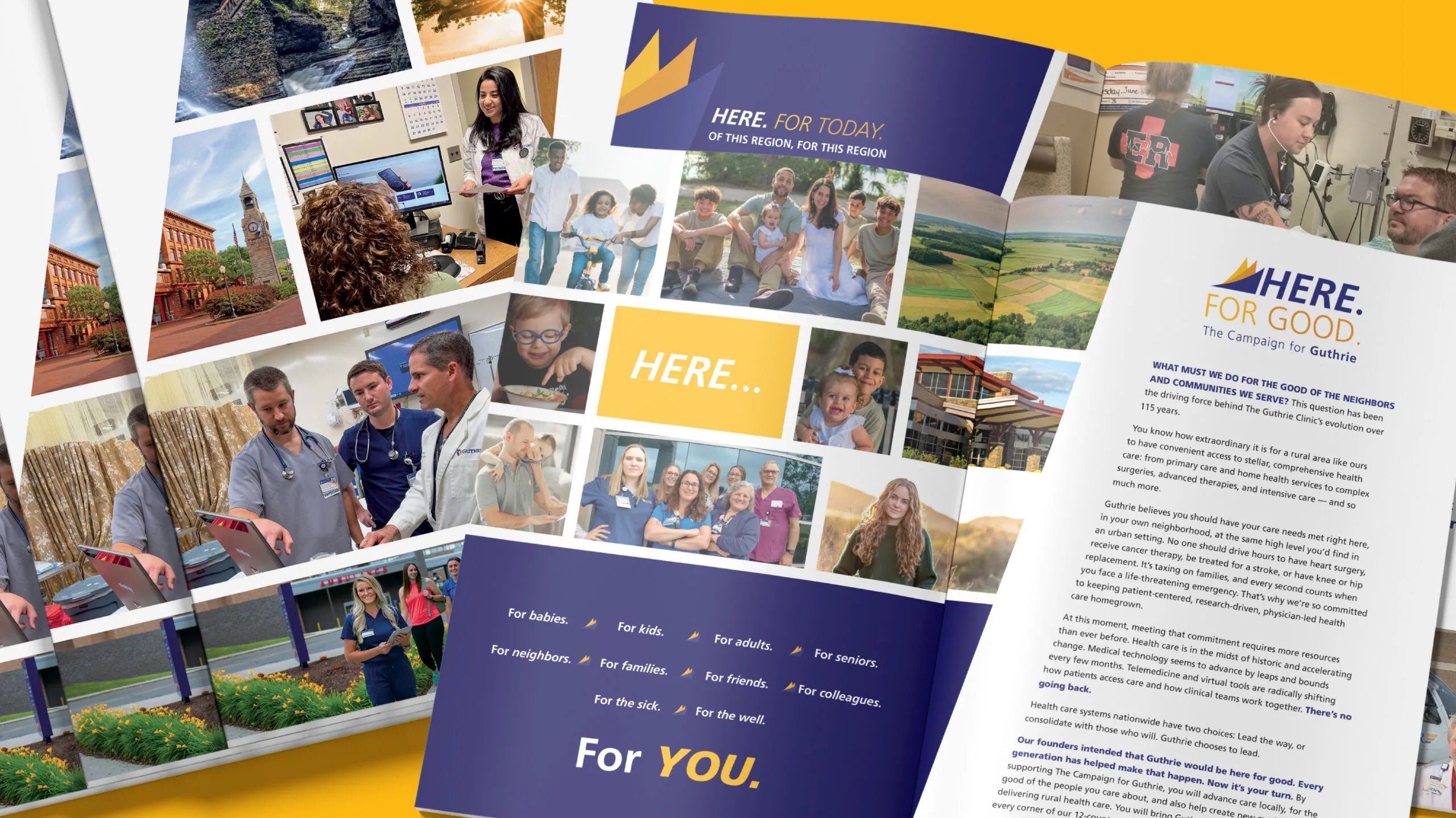

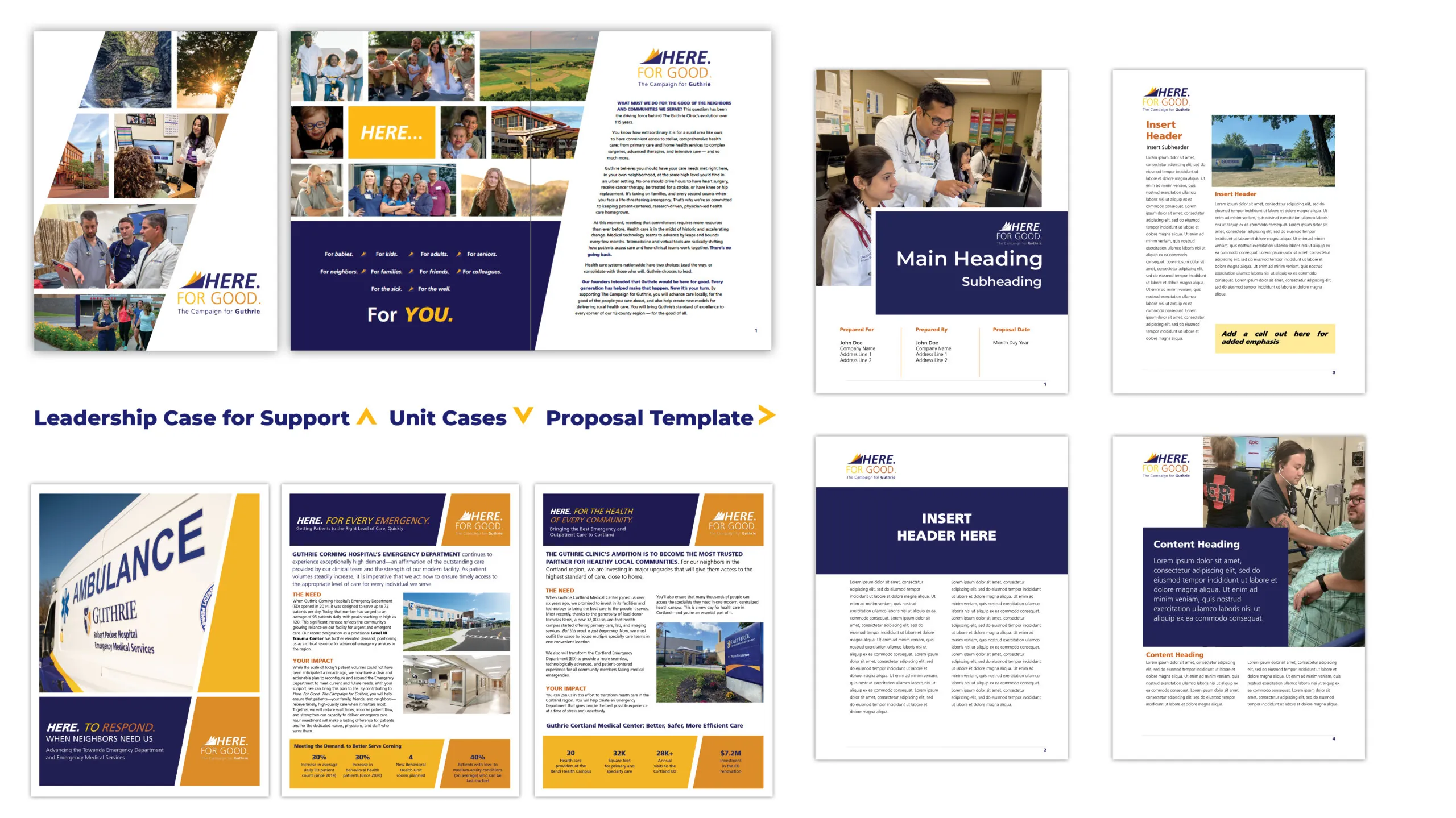
Leadership Case for Support
A 16-page narrative document designed for principal gift conversations. Built around the “Why Now? Why Here? Why This?” framework, it presents Guthrie’s four campaign pillars (Model for Rural Health Care, Advancing Care Locally, Elevating the Standard of Care, and Unleashing the Power of Caregivers) with the strategic depth major donors expect.
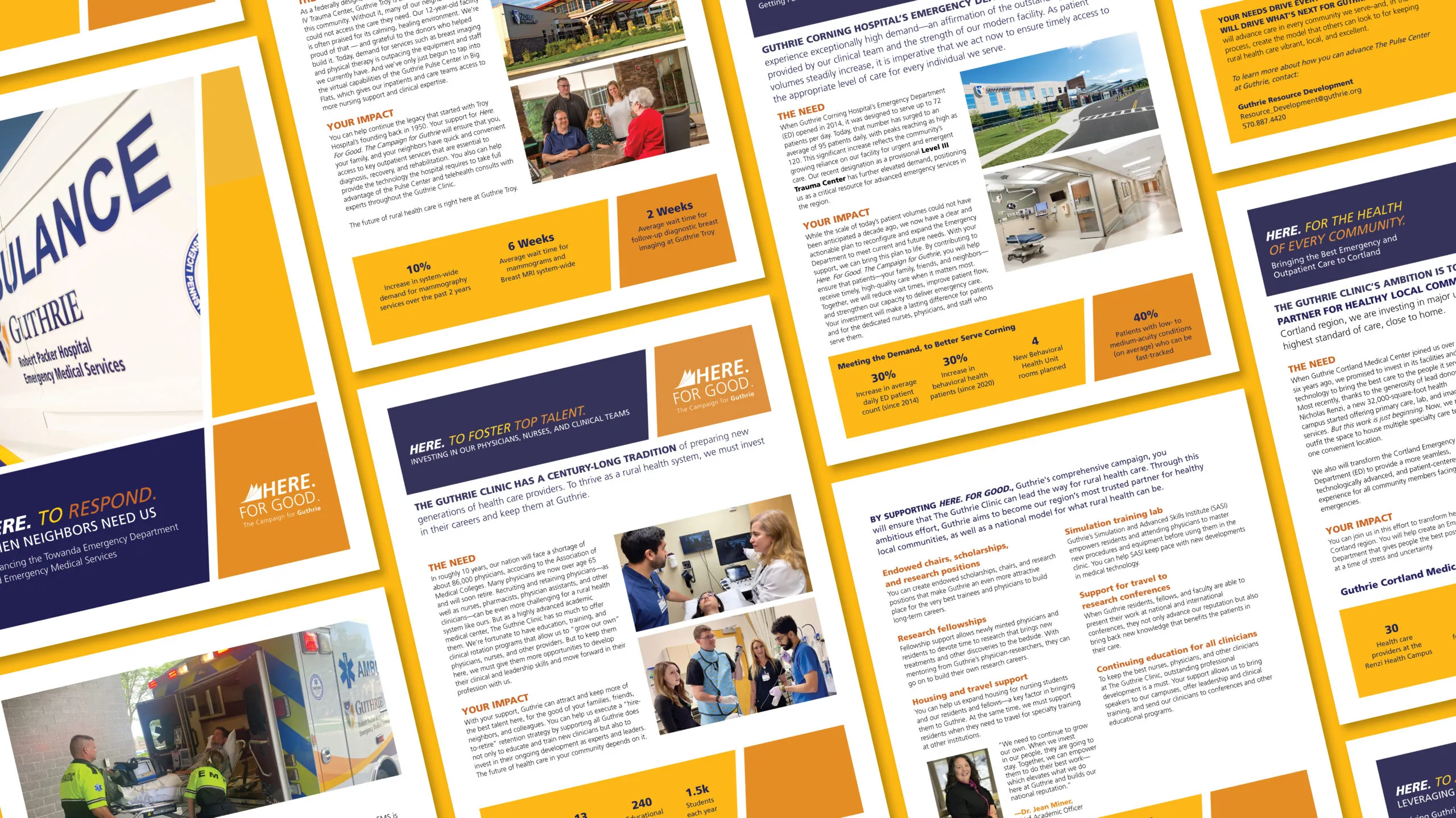
Priority Cases
Six priority-specific cases translating Guthrie’s campaign pillars into focused philanthropic opportunities. Each piece connected a distinct giving area (Workforce Education and Development, Troy Community Hospital, the Guthrie Pulse Center, Investment in Cortland Community, EMS, and the Towanda ED and Corning Hospital) to the overarching Here. For Good. campaign rationale, demonstrating how investments in specific facilities and programs directly advance Guthrie’s commitment to keeping excellent care close to home.
Major Donor Proposal Suite
A tiered proposal system designed to serve the full range of principal gift conversations. The suite includes a usage guide orienting gift officers to when and how to deploy each format, alongside 4-, 6-, and 8-page templates calibrated to gift complexity and relationship depth. Each template translates campaign priorities into personalized philanthropic arguments without requiring gift officers to build from scratch.
The Results
Lasting Impact
The campaign helped shape how Guthrie articulates its value to the communities it serves. Gift officers now approach donor conversations with framework-grounded confidence, adapting core messages to individual motivations rather than reciting talking points.
Messaging Architecture Adopted
The “Why Now? Why Here? Why This?” framework has become embedded in how leadership discusses philanthropic priorities, from board presentations to community events to award submissions.
Cross-Functional Fluency
Training extended beyond development staff to marketing and communications teams, ensuring message consistency whether the audience is a prospective donor, a local newspaper, or a grant application.
Donor Motivation Mapping
The “Why You?” addition gave gift officers a systematic approach to personalizing conversations based on individual drivers, moving from institutional pitch to authentic dialogue.
Capacity Beyond This Campaign
The messaging platform and fluency training created institutional capacity that extends beyond the current effort, equipping Guthrie to refresh and extend materials as priorities evolve.
Beyond the Campaign
One Relationship, Two Kinds of Work
The Here. For Good. campaign was not Foster Avenue’s only work with Guthrie. In parallel with campaign development, Foster Avenue partnered with The Guthrie Clinic’s Cardiovascular Service Line on a distinct challenge: building a unified messaging foundation for one of the region’s most clinically sophisticated programs.
That engagement required a different kind of discovery. Where campaign work asks donors why they should invest, service line messaging asks clinicians and administrators how they describe what they do, and what makes them worth choosing.
Through interviews with physicians, advanced practice providers, and medical group operations staff conducted in early 2025, Foster Avenue developed a comprehensive strategic message platform that gave the cardiovascular team shared language: a positioning statement, core values, value proposition, mission, vision, key messages, and audience-specific elevator pitches calibrated for everything from a 30-second hallway conversation to a two-minute donor meeting.
The two engagements reinforced each other. A cardiovascular team that could articulate its own clinical identity with clarity was better positioned to make the case for philanthropic investment. Institutional fluency at the service line level and campaign fluency at the donor level are different skills, and Guthrie built both.